
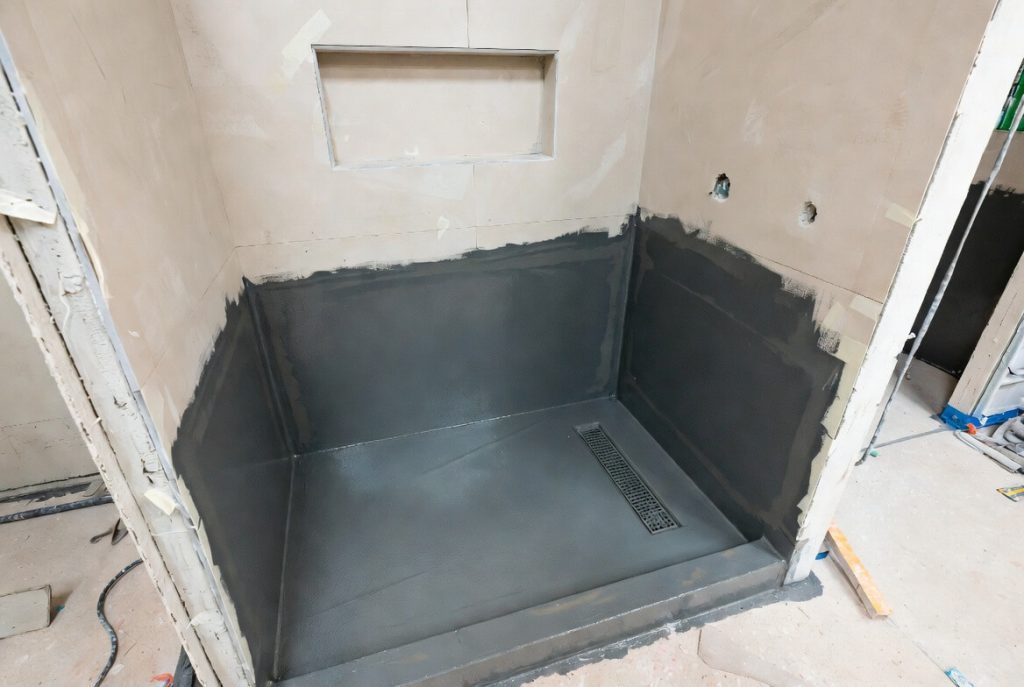
Ask most homeowners what keeps a shower from leaking and they’ll point at the tile and grout. It’s a fair guess – and it’s wrong. Tile is water-resistant, not waterproof, and grout is porous by nature. Water passes through both. What actually keeps water out of your walls and subfloor is a system you never see, built in before the first tile goes on. In Barrie and the GTA, where a bathroom gets used hard through a long winter, that hidden layer is the difference between a shower that lasts twenty years and one that rots the wall behind it in five.
Tile and grout are not waterproof
This is the part that surprises people. Grout soaks up water, and even sealed grout gives way over time. Water works its way through the joints, behind the tile, and keeps going – into the backer board, the studs, the subfloor. If there’s nothing waterproof underneath, there’s nothing stopping it. What you get is slow, hidden damage: mold in the wall cavity, soft framing, and eventually a repair that means tearing the whole shower out. None of it shows on the surface until it’s expensive.
What a proper waterproofing system includes
Before any tile is set, a shower should be built as one sealed envelope. On our builds that means:
- A pre-sloped pan that moves water toward the drain – not a flat floor that lets it sit
- A bonded waterproofing membrane across the walls, floor and curb, with no gaps at the seams
- Corners, seams and changes of plane sealed and reinforced – the first places water tries to get through
- The niche and any bench waterproofed in full, not just tiled over
- The drain tied into the membrane, so water can’t slip underneath it
Every one of these disappears the moment the tile goes on. That’s exactly why it’s the first thing skipped on a rushed job.
Where showers actually leak
When a shower fails, it’s almost never the open field of tile. It’s the details:
- The corners, where two planes meet and the membrane has to wrap without tearing
- The niche, cut into the wall and easy to waterproof badly
- The pan-to-drain connection, where a shortcut can hide for years
- Changes of plane – bench tops, curbs, the base of the walls
A shower can look flawless and still be feeding water into the wall at one of these points. By the time it shows as a stain or a smell, the damage behind the tile is already done.
The flood test: proof before a single tile goes on
Here’s the step that separates a shower built right from one built fast. Before we tile, we plug the drain, flood the pan, and leave it. If the water level holds overnight and nothing shows below, the waterproofing is doing its job – and we tile over proof, not hope. It adds a day to the build. It’s the cheapest insurance in the whole project.
Why waterproofing can’t be an afterthought
You can’t add waterproofing to a finished shower. It lives under the tile, so fixing it later means taking the tile back off – which is why a shower that was cheap to build is so often expensive to own. This is the one place in a bathroom where cutting the corner never pays. Done right, it’s invisible and you forget it exists. Done wrong, it’s the reason for every repair that follows.
If you’re planning a shower or bathroom and want it built to hold up – not just look good on handover day – waterproofing is the part worth asking about first. We’re happy to walk you through how we’d build yours.